
Brand Awareness Through Digital Marketing: Your Integrated Admin, Marketing & Lead Generation Support Team

What is brand awareness through digital marketing? Brand awareness through digital marketing means using online content, search, social media, email, and lead generation activities to help potential clients recognise and remember a coaching business. Strong awareness also depends on consistent communication, reliable follow-up, accurate CRM records, and administration that supports every client interaction. How does brand awareness through digital marketing work? Digital marketing helps coaches appear consistently across the channels their potential clients use. Content can introduce expertise, while search visibility, social activity, email communication, and lead follow-up help turn recognition into meaningful conversations. Why is consistency important for coaching brands? A coach can lose potential clients if their content says one thing while their emails, website, scheduling process, or follow-up says another. Consistent messaging across connected business activities creates a clearer experience and makes the brand easier to remember. Why are we more than just brand awareness through digital marketing? Best Virtual Specialist combines administration, digital marketing, lead generation, and AI-powered support into one coordinated virtual team. This means marketing activity connects with CRM updates, scheduling, client communication, lead management, and operational tasks instead of functioning as an isolated service. How can coaches build brand awareness through digital marketing? Coaches can build awareness by consistently sharing useful expertise and connecting that visibility to practical business processes. Content should lead prospects toward relevant next steps, while CRM management, follow-up, scheduling, and administration ensure interested prospects receive timely support after engaging with the brand. What content helps coaches build brand recognition? Educational articles, social posts, videos, case studies, newsletters, and useful resources can demonstrate a coach’s expertise. The strongest content addresses specific client problems and gives people a reason to remember the coach when they need support. How does lead generation support brand awareness? Lead generation gives interested prospects a clear path from awareness to action. A coordinated process can capture enquiries, update CRM records, assign follow-up tasks, and support communication so visibility does not end when someone submits a form. How can AI support brand awareness activities? AI can help with content research, workflow automation, data organization, lead sorting, and repetitive communication tasks. Human oversight remains important for maintaining the coach’s voice, reviewing quality, and handling relationship-based conversations. Why should marketing connect with administration and lead management? Marketing works better when it connects directly with the activities that follow a prospect’s first interaction. For coaches, an integrated workflow can connect content and campaigns with lead capture, CRM updates, email communication, appointment scheduling, and follow-up, reducing gaps between attracting attention and building relationships. How does poor CRM management affect marketing? Incomplete or outdated CRM records can cause duplicate messages, missed follow-ups, and poor visibility into prospect activity. Keeping records accurate helps the support team understand where each lead stands and what action should happen next. Can administrative support improve the client experience? Yes. Fast scheduling, organised communication, accurate records, and timely follow-up make interactions easier for prospective and existing clients. These operational details also influence how people perceive the professionalism of a coaching brand. How does integrated support reduce missed lead handoffs? One coordinated team can share information across marketing, lead generation, administration, and CRM workflows. This reduces the chance that a marketing-generated enquiry sits unanswered because responsibility was unclear between separate contractors. Should coaches hire separate freelancers or one integrated support team? Separate freelancers can provide specialist skills, but coaches often become responsible for coordinating those specialists. Best Virtual Specialist uses an integrated team model that connects administration, marketing, lead generation, and AI support, helping reduce communication gaps, duplicated work, slow follow-up, and the time spent managing multiple contractors. What problems can separate freelancers create? Different freelancers may work in separate systems and follow different processes. This can create disconnected marketing, duplicated tasks, inconsistent communication, and delays when one person’s work depends on another contractor. How does one integrated team reduce admin overload? A coordinated team can manage connected workflows instead of requiring the coach to transfer information between several people. This gives the coach one support structure for administrative tasks, lead activity, marketing workflows, and AI-assisted processes. Is an integrated team better for growing coaching businesses? It can be particularly useful when the coach has increasing leads, content demands, client communication, and administrative work. Instead of adding another contractor for every new task, the coach can work with a team that coordinates multiple functions. How should coaches measure digital brand awareness? Coaches should measure more than impressions and follower counts. Useful indicators include branded searches, website traffic, content engagement, enquiries, email responses, lead quality, consultation bookings, and how efficiently the team moves prospects from initial awareness into follow-up. What metrics show whether awareness is producing business value? Look at the relationship between visibility and action. Increased website visits matter more when they lead to relevant enquiries, consultations, email engagement, or qualified prospects entering the CRM. How can coaches identify gaps in the customer journey? Review each stage from first contact to consultation. Check whether prospects receive clear information, enter the CRM correctly, receive timely follow-up, and have an easy way to schedule the next conversation. Why should coaches track follow-up alongside marketing? Marketing can generate attention, but follow-up determines what happens after someone expresses interest. Tracking both activities helps identify whether lost opportunities come from weak visibility or from operational gaps after a lead arrives. What makes Best Virtual Specialist different for coaches? Best Virtual Specialist provides a coordinated team of virtual specialists who work across administration, digital marketing, lead generation, and AI integration. The goal is to connect the entire support process, from attracting prospects and managing leads to updating systems, communicating with clients, scheduling appointments, and completing administrative work. What support can coaches receive beyond marketing? Support can extend across CRM management, scheduling, inbox administration, lead follow-up, client communication, content workflows, and AI integration. These functions work together so marketing activity has operational support behind it. How can an integrated team save coaches time? The team reduces the need for coaches to coordinate separate contractors or
Full Stack Digital Marketing for Coaches: Connecting Marketing, Lead Generation & Admin Support
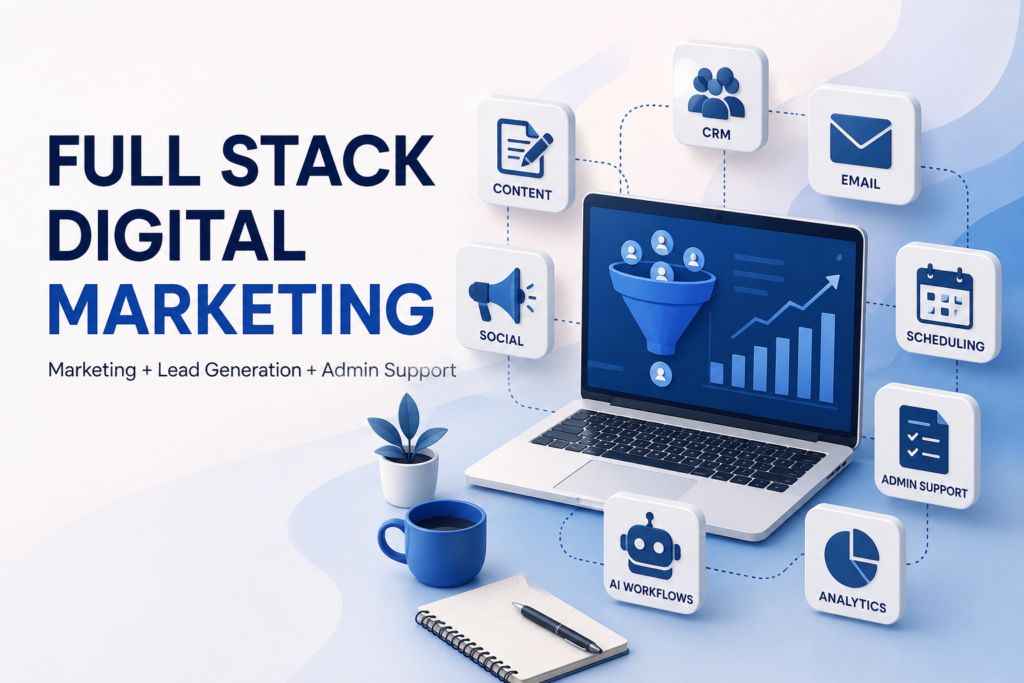
What is the full stack digital marketing for coaches? Full stack digital marketing refers to managing the connected activities that move a prospect from awareness to enquiry and follow-up. For coaches, this can include content, lead generation, CRM updates, email communication, scheduling, reporting, administration, and AI workflows. The value comes from connecting these activities instead of treating marketing as an isolated task. What does full stack digital marketing include? It can include content creation, search optimization, social media, email campaigns, lead capture, CRM management, analytics, and follow-up. For a coaching business, these activities work best when they connect with daily administration and client communication. Why does integrated support matter for coaches? Coaches often lose time switching between marketing tasks, emails, scheduling, CRM updates, and lead follow-up. A coordinated team can keep information moving between these functions, reducing missed handoffs and duplicated work. Why are we more than just full stack digital marketing? Best Virtual Specialist combines administration, digital marketing, lead generation, and AI-powered support through one coordinated virtual team. This gives coaches support across the business workflow rather than assigning marketing to one person and administrative tasks to someone else. How can full stack digital marketing support a coaching business? Full stack digital marketing can help coaches create a connected path from visibility to booked conversations. Instead of producing content without follow-up, the process can connect marketing activity with lead capture, CRM updates, communication, scheduling, and administrative support so opportunities do not get lost. How does marketing connect with lead generation? Marketing attracts attention, while lead generation turns interest into identifiable prospects. Connecting both means new enquiries can enter a CRM, receive appropriate follow-up, and move toward a consultation without relying on manual handoffs. How can AI improve digital marketing workflows? AI can assist with research, content workflows, lead sorting, data entry, follow-up preparation, and repetitive administrative tasks. The goal is to reduce repetitive work while keeping human judgement involved in client-facing decisions. What administrative tasks should connect with marketing? Scheduling, inbox management, CRM updates, contact records, proposal preparation, and follow-up tracking can connect directly with marketing activity. This prevents a situation where marketing generates leads but nobody has clear responsibility for what happens next. Is hiring separate freelancers better than using one integrated support team? Hiring separate freelancers can work for a business with strong internal coordination, but it can create communication gaps between marketing, lead generation, and administration. Best Virtual Specialist uses one coordinated team of virtual specialists, helping coaches reduce contractor management, duplicated effort, inconsistent processes, and missed follow-up. What problems can separate freelancers create? Different freelancers may use separate systems, communication methods, schedules, and working processes. Without strong coordination, leads can wait for follow-up while another contractor continues generating new enquiries. How does one integrated team reduce admin overload? A coordinated team can share workflows and information across administration, marketing, lead generation, and AI support. Coaches spend less time explaining the same process to multiple contractors or checking whether one task depends on another. Can one team maintain more consistent client communication? Yes. Shared processes and access to relevant information make it easier to keep communication consistent. This is especially useful when enquiries, appointments, CRM records, and client follow-up involve several connected tasks. What should coaches look for in an integrated virtual support team? Coaches should assess whether a support team can connect daily operations with marketing and lead management. Look for clear workflows, reliable communication, CRM capability, AI knowledge, lead follow-up processes, and the ability to support multiple business functions through one coordinated team. Should a virtual team understand CRM management? Yes. CRM management helps ensure that enquiries, conversations, follow-up actions, and customer information remain organized. A team that understands CRM processes can support both lead generation and administration more effectively. How important is lead follow-up? Lead follow-up is critical because an enquiry has little business value if nobody responds promptly. A coordinated support team can track new leads, update records, prepare follow-up, and ensure opportunities do not disappear between marketing and sales activities. Why should AI and human support work together? AI can handle repetitive tasks and support faster workflows, while people provide judgement, communication, relationship management, and quality control. Combining both can give coaches greater efficiency without removing the human element from their business. Why is Best Virtual Specialist a complete support model for coaches? Best Virtual Specialist brings administration, digital marketing, lead generation, and AI integration into one coordinated virtual support team. This model helps coaches avoid managing disconnected specialists while keeping marketing, operations, CRM activity, communication, and follow-up connected to the same business goals. What does Best Virtual Specialist handle beyond marketing? The team can support administrative workflows, CRM updates, lead management, scheduling, client communication, digital marketing, and AI-powered processes. These functions work together rather than operating as separate services. How can integrated support save a coach time? It reduces the need to coordinate multiple contractors and repeatedly transfer information between them. Coaches can spend more time delivering coaching and developing their business while the support team manages connected operational workflows. Is this model suitable for growing coaching businesses? It can be useful when a coaching business has enough activity that administration, marketing, and lead follow-up compete for the owner’s attention. An integrated team provides broader support without requiring the coach to personally coordinate every function. What is the main benefit of full stack digital marketing for coaches? The biggest benefit is connection. Full stack digital marketing becomes more useful when marketing activity connects with administration, lead generation, CRM management, communication, scheduling, and AI workflows. For coaches, this creates a support system where leads and tasks can move forward without constant owner involvement. What should coaches prioritise first? Start with the workflow causing the greatest loss of time or missed opportunities. This may be inbox management, lead follow-up, CRM maintenance, content production, scheduling, or repetitive administrative work. How should coaches measure whether support is working? Track practical outcomes such as response times, follow-up completion, booked consultations, CRM accuracy, administrative hours
Executive Branding Support with Virtual Specialists: Simple Steps to Grow Your Leadership Presence
Building a strong executive brand helps leaders stand out. It shows who you are, what you stand for, and the value you bring. Many executives, including coaches and speakers, work with teams of virtual specialists who act as productivity partners, guided by a full stack digital marketer, to support branding, organization, and execution. This structure frees time and helps leaders stay focused on high-impact work. In this article, you will learn how executive branding support works, how remote executive support boosts productivity, and how online brand management raises your leadership profile. You will also see how coaches and speakers can use productivity partners to grow their influence with clarity and consistency. 1. Enhancing Your Leadership Presence with Executive Branding Support Executive branding support shapes how others perceive your leadership. It defines your message, highlights your expertise, and aligns your values across professional platforms. For coaches and speakers, a strong personal brand drives trust, credibility, and opportunity. Executive branding support helps maintain consistency through content development, profile optimization, and message alignment. This approach is often strengthened by AI-supported branding strategies that improve clarity and relevance at scale. Best Virtual Specialist operates as a team of virtual specialists working together as productivity partners, guided by a full-stack digital marketer. This ensures branding tasks are handled with structure and continuity rather than as isolated activities. This allows leaders to focus on coaching, speaking, and strategic thinking while their brand remains visible and aligned. ➨ Here are the best practices about AI Integration in Executive Branding with a Virtual Specialist 2. Boosting Efficiency Through Remote Executive Support Coaches and speakers manage demanding schedules that include client work, speaking engagements, and content responsibilities. Remote executive support focuses on creating structure, organization, and flow across daily operations. Productivity partners help manage coordination, scheduling, and follow-through so leaders are not overwhelmed by logistics. This reduces friction, prevents missed commitments, and supports better preparation. With a productivity-partner model, support is proactive rather than reactive. Leaders stay ahead of deadlines and maintain consistency even during high-demand periods. ➨ Here`s what you need to know about Business Productivity Partner that elevates beyond traditional VA services 3. Leveraging Online Brand Management for Executive Success (Keyword: Online brand management for executives) Your online presence directly influences your professional reputation. Online brand management ensures your profiles, content, and engagement reflect your leadership positioning. For coaches and speakers, this visibility builds authority with clients and event organizers. A coordinated team approach ensures consistent posting, engagement, and messaging across platforms. AI-enabled processes also help refine content and maintain relevance over time. Online brand management includes monitoring feedback and managing public perception. Productivity partners help ensure timely responses and brand alignment, protecting long-term credibility. ➨ Here’s what you need to know about how executive branding shapes others’ perception of your expertise and presence. Why Coaches and Speakers Need Virtual Specialists Coaches and speakers rely on trust, visibility, and execution. Working with a team of virtual specialists acting as productivity partners allows them to maintain high standards without hiring full-time internal staff. Instead of relying on a single individual, productivity partners bring combined expertise across branding, content, and operations. Guided by a full-stack digital marketer, this team-based model is flexible, scalable, and cost-efficient, making it ideal for leaders with dynamic schedules and growing demands. How to Start with Executive Branding Support Begin by defining your executive brand clearly. Identify your leadership voice, areas of expertise, and audience. Next, determine which functions require support, such as branding execution, online presence management, or workflow organization. Communicate expectations clearly and establish regular reviews. Use shared tools to maintain visibility and alignment across tasks. This ensures productivity partners operate as an extension of your leadership, not a separate function. Tips for Coaches and Speakers to Get the Most from Remote Executive Support Clear communication builds trust and strengthens long-term collaboration. Online Brand Management Best Practices for Coaches and Speakers These actions help you grow your following and attract clients. Conclusion Executive branding support combined with remote executive support helps coaches, speakers, and leaders strengthen their presence while staying focused on their core strengths. Online brand management improves credibility, visibility, and audience connection. Best Virtual Specialist operates as a team of virtual specialists working as productivity partners, guided by a full-stack digital marketer, providing structured, flexible, and scalable support. This approach allows leaders to build a strong, trusted executive brand without distraction. By defining your brand clearly, working with productivity partners, and applying consistent systems, you can lead confidently and grow your leadership presence with purpose. Book a strategy call today and let Best Virtual Specialist serve as your Productivity Partners—a dedicated team of virtual specialists, guided by a full-stack digital marketer, supporting your executive brand with the right tools, strategy, and consistent execution so you can lead with clarity and confidence. Explore our affordable VA pricing plans and choose the option that best aligns with your workflow.
AI Integration in Marketing: Personalization Without Losing Authenticity
Artificial intelligence (AI) has transformed marketing from mass messaging into meaningful engagement. Algorithms now analyze behaviors, predict needs, and tailor experiences in real time. Yet, while AI brings precision and speed, it also raises an essential question: How can brands personalize without losing authenticity? The answer lies in using AI not as a substitute for human connection, but as a bridge that deepens it. The Power and Paradox of AI Personalization AI personalization allows marketers to reach people at the right time with the right message. From Netflix recommendations to Spotify playlists, data-driven personalization creates the illusion of a one-to-one relationship. In marketing, this means crafting campaigns that resonate with each customer’s unique intent, not just their demographics. However, technology that enables personalization can also lead to depersonalization. When consumers detect that messages are overly tailored or clearly algorithm-driven, they become aware of the automation at work. This causes the loss of authenticity in personalized marketing that happens when brands focus more on optimization than emotional connection. True personalization should enhance connection, not replace it. AI can uncover insights about what people care about, but it’s the human storyteller who interprets those insights with empathy and creativity. When marketers let data guide decisions but allow humanity to shape the message, personalization becomes meaningful instead of mechanical. Balancing Data and Humanity in AI Integration The future of marketing depends on human-centered AI, where machines analyze data and automate tasks, while humans apply emotional intelligence and ethical judgment. AI can predict which content will perform best, but it can’t feel joy, nostalgia, or humor. That’s the marketer’s domain. The human role is to inject intention, ethics, and empathy into what AI suggests. For example: Transparency also supports authenticity When brands explain how they use AI, they build trust instead of suspicion such as clarifying that recommendations are based on customer preferences or that a chatbot is AI-powered. Consumers are no longer intimidated by AI, but they simply want honesty about how it shapes their experience. Ethical use of data reinforces this trust. Collect only what’s necessary, obtain clear consent, and use insights responsibly. Ethical AI isn’t just about compliance, but it’s a moral foundation that protects both brand credibility and customer loyalty. ➨ Want to learn how to build an AI-driven marketing strategy tailored for small businesses? Explore our AI Marketing Strategy Guide for Small Business. Authentic Marketing Through Personalization with Purpose AI must make marketing feel attentive, not automated. Marketers should use AI to create authentic, purposeful personalization that deepens customer understanding while keeping the brand’s true voice alive. Brands that thrive in this balance see AI as a creative collaborator, not a competitor. Tools like ChatGPT, Jasper, and predictive analytics can assist in idea generation, testing, and optimization, but they require human oversight to ensure tone, empathy, and meaning remain intact. When marketers combine AI’s analytical precision with genuine storytelling, they create scalable authenticity that connects deeply with many people without sounding manufactured. In the end, authenticity isn’t about avoiding technology. It’s about using it wisely. AI can process the data, but only humans can express the heart behind it. Brands that listen intelligently, communicate transparently, and connect emotionally will lead the future of marketing. AI makes personalization possible, but humanity makes it powerful. When data and empathy move in sync, marketing becomes not just smart, but sincerely human. Want to see how productivity partners drive real business growth? Check out our guide on AI Productivity Partners and Business Growth. Conclusion AI integration in marketing doesn’t replace human creativity but amplifies it. When data-driven precision meets genuine storytelling, brands achieve personalization that feels intelligent and authentic. The key lies in maintaining balance. Using AI to understand audiences deeply while keeping human empathy at the heart of every message. In this era of automation, authenticity remains the ultimate competitive edge. Partner with Best Virtual Specialist to bring balance between AI innovation and authentic marketing. Let’s integrate smart solutions that keep your brand human. Book a free consultation now and explore what sets us apart. Resources:
Full Stack Digital Marketing Consultant & Productivity Partner for Modern Businesses
Modern businesses use digital marketing to grow leads, sales, and customer trust. Many companies hire virtual assistants to manage daily tasks such as posting content, sending emails, or updating websites. These tasks get done, but results often fall short. The problem is not effort. The problem is lack of direction. Instead of doing everything themselves, a full stack digital marketing consultant guides a team of virtual specialists who serve as productivity partners. Each specialist handles a defined task, while the consultant controls strategy, priorities, and performance. This approach ensures more efficient execution, better business results, and higher client satisfaction. Businesses use time and budget with purpose, and actions align with clear goals Many virtual assistants work on instructions alone, completing tasks without reviewing data, monitoring customer responses, or connecting actions to broader goals. This creates activity without growth. Research shows that lack of supervision and coordination often leads to isolated task execution (Beharay & Tilak, 2025). A full-stack consultant solves this by managing the entire marketing system, ensuring every action drives measurable results. AI-Powered Digital Marketing and Automation AI automation increases speed and accuracy in marketing operations. A full stack digital marketing consultant selects tools that support clear goals. These tools manage lead capture, email workflows, reporting, and system updates. Automation reduces manual work. Virtual specialists spend more time on execution that drives results. The consultant reviews performance data and adjusts workflows when results change. This process improves consistency and reduces waste. AI also supports better decision making. Data flows into dashboards that show traffic, leads, and conversions. The consultant uses this data to refine campaigns and improve efficiency across channels. End-to-End Digital Marketing Solutions Marketing produces results when channels work together. A full stack digital marketing consultant manages SEO, content, email marketing, social media, paid ads, and website performance as one system. SEO attracts qualified traffic. Content builds trust and clarity. Email supports follow up and retention. Paid ads increase reach and speed. The website converts visitors into leads. The consultant ensures each channel supports the next step in the customer journey. This system removes gaps. Prospects receive clear messages at each stage. Teams avoid duplicated effort. Businesses gain steady and predictable growth. Business Productivity-Focused Marketing Partners A productivity partner focuses on results, not volume. A full stack digital marketing consultant reviews how teams use time and budget. The consultant removes low value work and increases focus on actions that produce returns. This approach improves clarity. Teams know what matters and why it matters. Leaders receive reports that show progress in simple terms. Marketing supports sales and customer experience in measurable ways. Productivity also improves through planning. The consultant sets priorities and timelines. Virtual specialists follow a clear direction. This structure reduces confusion and delays. Transform isolated efforts into results by working with a full-stack consultant and business productivity partners, a dedicated team of virtual specialists. Virtual Marketing Team Led by a Full Stack Consultant A virtual marketing team needs leadership to succeed. Without leadership, specialists work in isolation. They complete tasks without feedback or coordination. A full stack digital marketing consultant guides the team with defined goals. Each specialist understands their role in the system. The consultant reviews output, shares insight, and updates direction based on results. This leadership improves quality and consistency. Customers receive a smoother experience. Marketing actions support long term business goals instead of short term activity. Why This Model Works for Modern Businesses This model works because it connects strategy, execution, and measurement. A full stack digital marketing consultant ensures that every marketing task aligns with business goals. Virtual specialists follow clear directions, and automation supports consistent results. Marketing stops being a collection of separate tasks and becomes a unified system that drives growth. Businesses gain better control and visibility. Leaders see how each channel contributes to sales and customer experience. Teams understand priorities and focus on work that produces results. The consultant monitors performance across all channels and makes adjustments based on data. This reduces wasted effort and ensures every action matters. By guiding a team of virtual specialists who act as productivity partners, modern businesses achieve more efficient execution, higher success, and greater client satisfaction through this structured approach. Transform isolated efforts into results with Best Virtual Specialist by working with a full-stack consultant and business productivity partners, a dedicated team of virtual specialists. Resources:
Beyond Vanity Metrics: Why Conversions Define Startup Success and Not Clicks
Startups often measure success with numbers that look good but lack real value. Likes, views, and shares are easy to count but don’t show true growth or impact. These metrics may show awareness but rarely prove your message reached the right people or led to action. Startup success is defined not by visibility, but by conversions. Being chosen matters more than being seen. Marketing should build trust and move prospects from curiosity to commitment. Without conversion, viral campaigns become noise in a crowded feed. Stop Chasing Likes. Start Building Sales Pipelines. Chasing likes can feel like progress, but it only creates an illusion of traction. Engagement without intent does not drive growth. A sustainable business needs leads, sign-ups, and revenue—not empty metrics. Instead of optimizing for visibility, startups should focus on creating a sales pipeline by having a consistent flow of qualified prospects who align with their solution. Building that pipeline requires clarity on who your ideal customers are, where they spend time, and what motivates them to act. Every post, ad, or email should guide that audience toward a tangible next step. Startups must move away from traditional marketing metrics to prove real content value. Focus on nurturing intent, not chasing attention. True performance is shown through meaningful actions like inquiries, open rates, and booked demos, not empty visibility. Why Startups Fail When They Mistake Attention for Trust Attention can be bought, but trust must be earned. Startups often assume exposure builds credibility. Today’s audiences are skeptical and can spot overpromising marketing easily.. Real trust is built through consistency, clarity, and transparency. Winning your audience begins with earning their confidence through authenticity. Sharing real stories, customer results, and behind-the-scenes insights creates stronger bonds than polished campaigns. When prospects trust your message, they engage meaningfully, not just passively. Startups that focus on trust build loyal communities. These communities boost credibility and turn followers into advocates and customers into partners. When Viral Visibility Masks Empty Results Viral content may get millions of views but often includes bot traffic that distorts analytics. Unauthorized bot traffic distorts analytics such as page views, bounce rate, and conversions, making it difficult to assess true performance. When this inflated visibility fails to generate sign-ups or sales, it becomes nothing more than digital noise. Virality grabs emotion but rarely intent. A funny or trending post spreads fast but misses chances to build real engagement if it doesn’t connect to your value. The best startups create content that invites action, not just clicks. True growth starts after the first impression. Every piece of content should educate, qualify, or guide the audience toward conversion. Viral success fades, but trust and intent create lasting impact. Redefining Success Through Meaningful Metrics The shift away from vanity metrics starts with redefining what success looks like. For startups, success should be measured not by how many see you, but by how many believe in you. Here’s how to make that shift practical: Map the steps from awareness to action. Guide your audience to subscribe, book demos, or request consultations. Instead of tracking likes, track time on page, email open rates, and click-to-conversion ratios. These indicate real interest, not passive attention. Move from one-time impressions to continuous interaction. Build communities around your brand through webinars, newsletters, or user groups. Use AI not to inflate numbers but to personalize communication and predict conversion patterns. AI-driven analytics can identify which messages resonate most with high-value leads. Content should solve problems, not just attract eyeballs. Educational storytelling establishes thought leadership and far stronger currency than virality. By focusing on metrics tied to value and intent, startups build systems that scale with integrity. They no longer need to rely on luck or algorithms for visibility because their strategies are built around real audience needs. Conclusion: Having many likes is not the problem. In fact, good engagement can strengthen brand visibility and open new opportunities. What becomes harmful is chasing likes and virality for their own sake while neglecting conversion, trust, and relationship-building. Startups can and should aim for both by having meaningful engagement and measurable results. The key is balance. When visibility builds trust, and trust leads to conversion, growth becomes sustainable and authentic. Likes bring attention, but trust and conversions bring validation. The most successful startups understand that numbers are only half the story. True success lies in turning attention into action, engagement into trust, and trust into loyalty. When startups learn to align popularity with performance, they stop chasing metrics and start building momentum that lasts. Ready to turn your startup’s visibility into real conversions? Partner with Best Virtual Specialist where every click leads to meaningful growth. Let’s build trust, optimize your metrics, and create a conversion-driven strategy that lasts. Resources:
How Brand Positioning Defines Market Perception: Full Guide (2025)
Even with expertise and innovation, a brand can go unnoticed without strong positioning. Discover how strategic brand positioning shapes market perception, attracts your ideal audience, and builds lasting trust
Importance of Digital Marketing on Brand Awareness
The importance of digital marketing on brand awareness continues to grow as more people rely on digital channels to discover, research, and engage with brands. Whether you’re a small business or a large enterprise, being present online is no longer optional. Digital marketing gives brands the tools to reach the right audience, stay visible, and leave a lasting impression. It allows businesses to build familiarity and trust through repeated, meaningful interactions [1]. Without a solid online presence, even the best offerings can get lost in the noise. How to Enhance Online Visibility Through Marketing Strategy Improving online visibility means showing up where your audience spends time. Here’s how to achieve that using a strong marketing strategy: 1. Leverage Social Media – Posting consistently on platforms like Instagram and LinkedIn creates ongoing engagement and exposure. 2. Optimise for Search – SEO helps your content rank on Google, bringing organic traffic that boosts brand recognition. 3. Use Paid Advertising – Running targeted ads increases reach and recall, even for new audiences. 4. Collaborate with Influencers – A great way to expand reach by building trust through familiar personalities [2]. ➨Want practical ways to implement these strategies? Explore 5 essential digital marketing tips every startup should know to help you build visibility and traction online. Which Targeting Option is Best for Achieving Brand Awareness? How Virtual Specialists Help with Brand Awareness A virtual specialist can execute your digital campaigns, create content, manage ads, and track performance. They help maintain consistency and quality—key to building a strong presence online [3]. Final Thoughts The importance of digital marketing on brand awareness goes beyond just being visible. It’s about being recognised, trusted, and ultimately, chosen. A well-executed digital strategy ensures your brand shows up in the right places, speaks to the right people, and builds meaningful relationships over time. From targeted ads and engaging content to SEO and social media, each element works together to increase brand recall and customer loyalty. And you don’t have to do it alone.With the guidance of a skilled virtual specialist, businesses can apply these strategies consistently and effectively. Whether it’s managing campaigns, crafting content, or analysing data, having dedicated support can make all the difference in how your brand is seen and remembered. Book a free consultation today and work with a Virtual Specialist who can help your business grow through smarter digital marketing and turn visibility into real results. Curious about costs? Explore our Affordable VA Pricing Plan to see flexible options for reliable digital marketing support. References: [1] https://www.investopedia.com/terms/b/brandawareness.asp [2]https://www.researchgate.net/publication/376131896_Investigating_the_Impact_and_Effectiveness_of_Digital_Marketing_on_Brand_Awareness_Sales_and_Customer_Engagement [3] https://blog.hubspot.com/marketing/what-is-digital-marketing
Proof in the Performance: Client Success Through Digital Marketing
Digital marketing is more than just visibility. It’s about creating real results, building community, and growing with intention. The team has worked behind the scenes of many Digital Marketing Success Stories, crafting tailored strategies that turn ideas into momentum and campaigns into conversions. With the right mix of creativity and data, businesses are empowered not just to participate in the digital space but to stand out
Plug Into the Future: Embracing AI Integration Today

Discover how AI integration boosts productivity, decision-making, and branding for professionals and businesses navigating the digital landscape